


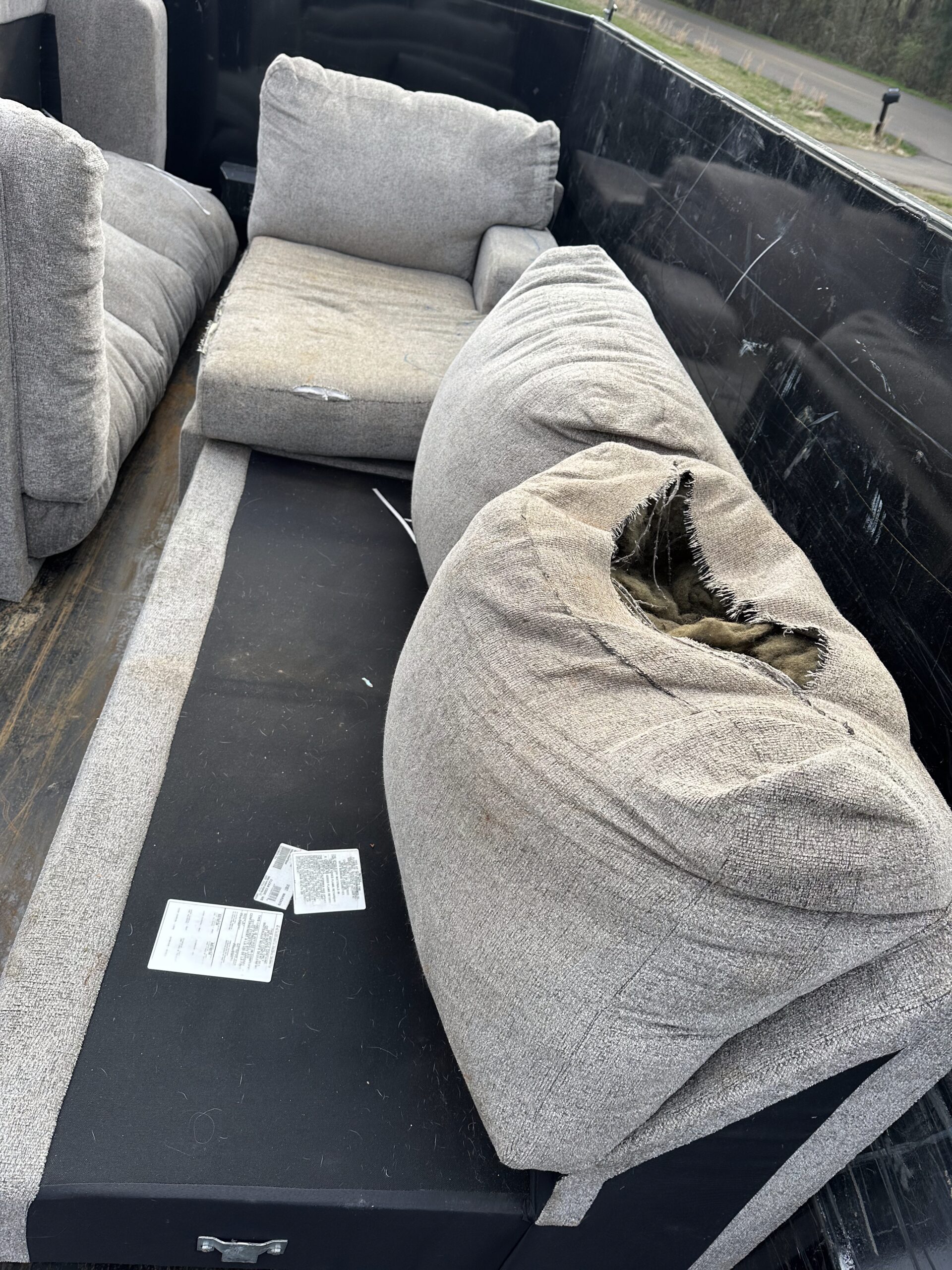


When your couch leaves the living room, it does not simply disappear. It enters one of three very different journeys, and the path it takes is usually decided in the first ten minutes after it hits the curb. Roughly 80 percent of a standard couch is recyclable, yet less than one percent of furniture actually gets recycled nationally. That gap between what could happen and what usually happens is the whole story.
A couch is one of the hardest things a waste system has to handle. It combines a wood frame, steel springs, polyurethane foam, synthetic fabric, glue, and staples, all fused into a single bulky object that a machine cannot easily pull apart. As a company that hauls furniture out of homes across Knox and Blount County every week, we see where these pieces end up, and the difference between a responsible haul and a lazy one is enormous.
Here is what actually happens to a discarded couch, the three routes it can take, and how to make sure yours takes the better one.
The Starting Line: The Curb
The moment a sofa lands on the curb, its fate starts narrowing. Weather is the first judge. Porous foam and fabric soak up rain like a sponge, and a single overnight storm can add hundreds of pounds of water weight while destroying any chance the couch had of being donated.
That is why timing matters more than most people realize. A clean, dry couch has options. A waterlogged one has almost none, because no charity will take it and its weight drives up disposal costs. If you are setting furniture out for pickup, a dry forecast is worth waiting for.
From the curb, the couch heads down one of three paths.

Path 1: The Landfill (The Most Common Fate)
Most curbside couches end up buried, and the process is faster and more final than people expect. This is the default outcome when a couch is thrown out through standard channels with no sorting step in between.
Here is how that path unfolds:
- The haul. A standard garbage truck arrives and the hydraulic compactor immediately crushes the couch, shattering the wooden frame the instant it is loaded. Once it is crushed, its fate is sealed.
- The landfill drop. The broken pieces are dumped into a landfill cell, then a heavy steel-wheeled compactor drives over the pile to pack it into a dense layer.
- The daily cover. Soil is spread over the compacted waste, sealing the couch underground.
- The long decay. The wood frame rots within a few years, but the synthetic foam and fabric can take centuries to break down.
The environmental cost runs deeper than lost space. The polyurethane foam in most sofas from the last few decades is treated with brominated flame retardants, a class of persistent chemicals that do not break down easily and can leach into landfill runoff over time. The engineered wood frame, held together with glues and resins, contributes to methane as it decomposes in the oxygen-starved depths of a landfill. And the synthetic fabrics behave essentially like plastic, staying intact for generations.
A single couch also swallows a surprising amount of landfill airspace, which is the finite volume a landfill has to work with. Multiply that by the millions of sofas discarded each year and bulky furniture becomes one of the heaviest burdens on regional waste systems.
Path 2: Professional Junk Removal (The Sorting Pivot)
Hiring a hauler that sorts changes the couch’s trajectory by adding an evaluation step before anything gets thrown away. This is the single most impactful choice a homeowner can make, because sorting is exactly the step a standard trash truck skips.
The process looks like this:
- On-site evaluation. Before lifting, the crew assesses the couch’s condition to decide whether it can be reused or needs to be broken down.
- The clean break. If the couch is gently used and structurally sound, it goes directly to a local charity or thrift store for a second life instead of a landfill.
- The tear-down. If the couch is ruined, it heads to a transfer station or sorting facility rather than straight to a dump.
- The component harvest. Workers strip the couch into separate material streams, pulling clean wood and steel springs away from the non-recyclable foam and fabric.
This is where the 80 percent figure becomes real. The steel springs and frame hardware go to scrap metal recyclers. The solid wood can be chipped for mulch or biomass. In facilities set up for it, the polyurethane foam is even reclaimed and reprocessed into rebonded carpet padding. Only a small fraction of genuinely unusable material ends up buried.
In East Tennessee, a couch in good shape has real donation value. Organizations like the Habitat for Humanity ReStore accept usable furniture and sell it to fund local home-building work, which keeps a perfectly good sofa in service and out of the ground. When you book full-service hauling and junk removal solutions that include sorting, you are effectively routing your old couch toward its best possible outcome without lifting a finger.
If you are trying to decide whether your couch belongs in the donate pile or the haul-away pile, our guide on where to donate versus throw away old furniture in Knoxville breaks down exactly which pieces local charities will and will not take.
Path 3: The Industrial Recycling Facility (The Modern Solution)
When a couch reaches a dedicated bulk-waste recycling facility, it goes through an intensive mechanical breakdown that recovers nearly all of its raw materials. These facilities are less common, but they represent where furniture disposal is heading.
The breakdown runs in stages:
- The shredder. Industrial shredders tear the entire couch into fist-sized chunks, doing in seconds what manual stripping does in minutes.
- Magnetic separation. Powerful overhead magnets pull the steel springs, staples, and frame hardware out of the shredded mix for scrap metal smelting.
- The foam rescue. Polyurethane foam chips are separated, cleaned, and baled to be melted down into rebonded carpet padding.
- The wood recovery. Clean structural wood is chipped for mulch or biomass fuel.
What remains after all that is only a thin sliver of mixed synthetic fabric that has to be landfilled. The technology exists to recover most of a couch. The barrier has never really been the materials. It is the labor and infrastructure required to separate them, which is exactly why the sorting step in Path 2 matters so much.
Why So Many Couches Still End Up Buried
If 80 percent of a couch is recyclable, why does almost none of it get recycled? A few forces work against it:
- Fused materials. Sofas are built as a single glued and stapled unit, which makes clean separation slow and expensive.
- Fast furniture. Low-cost, trend-driven furniture is designed for short lifespans, so more pieces get discarded and fewer are worth repairing.
- High labor cost. Manual deconstruction takes time, and time is the most expensive part of recycling furniture.
- Limited infrastructure. Dedicated upholstered-furniture recycling facilities are still rare in most regions, including much of East Tennessee.
- Contamination. A couch soaked by rain or infested with pests loses its donation and recycling value instantly.
None of these are reasons to give up on doing it right. They are reasons to be intentional about how you get rid of a couch in the first place.
How to Give Your Old Couch a Better Ending
You have more control over your couch’s fate than it might seem. Before it leaves your home, run through this short checklist:
- Assess honestly. If the frame is solid and the upholstery is clean, donation or resale should be your first move.
- Keep it dry. Do not let a donatable couch sit in the rain. Water weight and moisture damage push it straight toward the landfill.
- Donate what is usable. Local charities and thrift stores, including the Habitat ReStore, accept furniture in good condition and often coordinate pickup.
- Sell or give it away. Online marketplaces and local groups move usable sofas quickly, sometimes within a day.
- Ask before you book. If you hire a hauler, ask two questions directly: do you sort your loads, and do you work with local charities. The answers tell you everything about where your couch will end up.
- Deconstruct as a last resort. If the couch is truly done, a sorting hauler or recycling facility can still recover the metal and wood instead of burying all of it.
The most sustainable path is almost always the one that keeps the couch whole and in use. When that is no longer possible, a crew that separates materials is the next best thing.
Frequently Asked Questions
Can an old couch actually be recycled?
Yes. Roughly 80 percent of a standard couch is recyclable, including the steel springs and frame hardware, the solid wood, and the polyurethane foam. The barrier is not the materials but the manual labor to separate them, which is why a hauler that deconstructs and sorts recovers far more than a standard trash truck.
Will a charity take my used couch?
Only if it is clean, dry, and structurally sound. A couch with tears, deep stains, strong odors, water damage, or any pest history will be refused, because charities cannot resell it. If your couch is in good shape, local organizations like the Habitat ReStore will often accept it.
What happens to a couch in a landfill?
A garbage truck’s compactor crushes it on loading, then it is buried in a landfill cell and packed down under daily soil cover. The wood frame rots within a few years, but the synthetic foam and fabric can take centuries to break down, and the flame retardants in the foam can leach into landfill runoff over time.
What is the best way to get rid of a couch in Knoxville?
If it is usable, donate it or hand it off through a local marketplace so it stays in service. If it is worn out, hire a junk removal service that sorts its loads so the metal and wood get recycled instead of buried. Either way, keep it dry, since water weight and moisture damage push a couch straight toward the landfill.
The Bottom Line
Your old couch’s journey does not end at the curb. It ends in a landfill cell, in a second living room across town, or broken down into scrap metal and carpet padding, and which of those happens depends largely on the choices you make before pickup. A dry couch, a quick condition check, and a hauler that sorts can divert hundreds of pounds of material away from the landfill.
As Knoxville’s top-rated junk removal specialists, we route usable furniture to local charities, separate metal and wood for recycling, and send only true waste to the landfill. If you have a couch, sectional, or a whole room of furniture that needs to go, we will make sure it takes the better path.
Call Foothills Disposal at (865) 257-9184 for a free furniture removal quote across Knoxville, Maryville, and the surrounding East Tennessee area.